Temporary Tattoo Collection Donates 50% to Animal Rescue!
Posted on


Posted on
Posted on
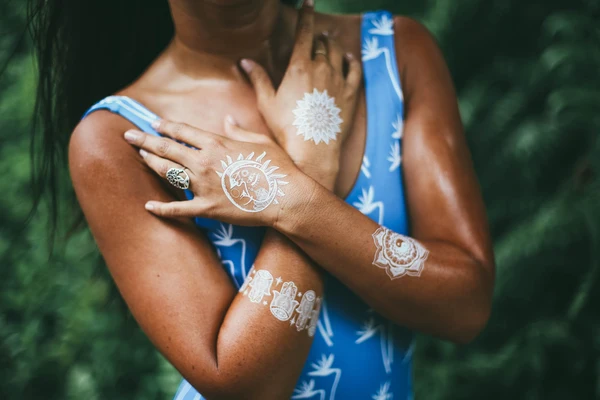
Negative space is the area a design leaves untouched. In tattoo art, that open space can create definition, movement, and contrast without relying on dense outlines or heavy shading. When paired with white temporary tattoos on dark skin, it becomes an especially expressive visual tool: the skin itself frames the design while pale details catch the eye.
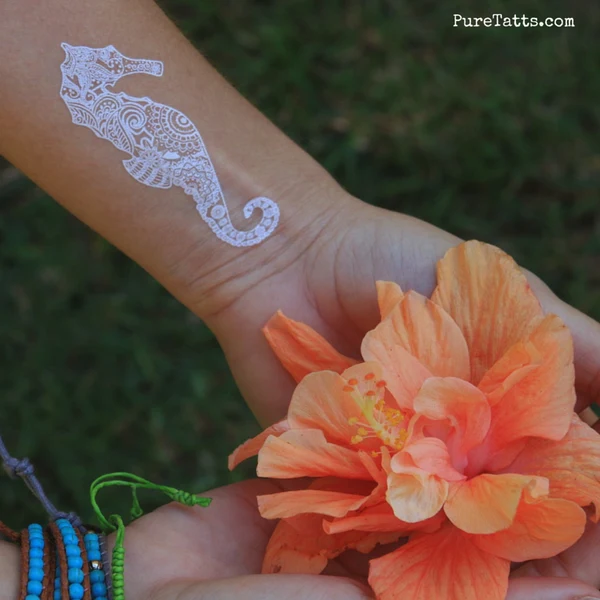
White designs can look graphic, delicate, or almost architectural. Fine lines may suggest lace, constellations, botanical veins, or geometric fragments, while broader areas of white create a striking silhouette. The result is a temporary body art style that feels intentional rather than decorative.
Because every skin tone reflects light differently, placement and scale matter. A detailed transfer should be selected with the same care as jewelry or clothing, allowing its contrast, texture, and empty space to work together. Collections of artist-drawn temporary tattoos offer an easy way to explore that balance without committing to permanent ink.
Negative space gives the eye somewhere to rest. Instead of filling every section with pigment, the design uses pauses to separate motifs and clarify the overall shape. On dark skin, white elements can act like highlights, making those open intervals feel even more deliberate.
A crescent with a wide gap, for example, may appear lighter and more refined than a solid moon. A floral design with untouched spaces between petals can preserve the delicacy of the drawing. The contrast comes from the relationship between the white mark and the surrounding skin, not from the mark alone.
This approach also gives temporary body art a modern quality. Minimal symbols, abstract geometry, and hand-drawn linework can appear bold without being oversized. The design has room to breathe, which helps it remain readable from a distance while rewarding a closer look.
The strongest white temporary tattoo designs usually have a clear visual hierarchy. A bold outer shape can support thinner interior details, while isolated dots or short lines can guide the eye across the skin. If every mark is equally fine, the image may lose definition; if every area is filled, the negative space disappears.
Scale is another important factor. Small white tattoos with sparse details often work well on fingers, wrists, ankles, and behind the ear. Larger compositions allow more room for radial patterns, ornamental borders, and layered linework across the shoulder, upper arm, back, or thigh.
Matte white finishes can create a soft, chalk-like effect, while high-contrast white transfers tend to look crisp and graphic. The right choice depends on the mood you want: quiet and ethereal, bold and futuristic, or ornamental and fashion-led.
White temporary tattoos are designed to sit on top of the skin, so their appearance differs from white permanent ink. A transfer can offer an immediate, luminous effect, but its final look depends on the skin’s natural texture, the location, and how smoothly it is applied. Slight curves, body hair, and dry patches can affect the edges.
A clean surface helps the design appear more even. Oils, lotions, and sunscreen may prevent the transfer from bonding properly, so skin should be washed and thoroughly dried before application. Once the tattoo is in place, avoiding unnecessary rubbing helps protect the fine negative-space details.
The contrast can also change under different lighting. Bright daylight may emphasize the sharpness of white lines, while warm indoor light can soften them. This shifting quality is part of the appeal: the tattoo may look crisp in one setting and subtly luminous in another.
Different finishes and design approaches create distinct effects on dark skin. Thinking about line weight, surface texture, and the amount of open space can make it easier to choose a piece that suits both your style and placement.
| Style | Visual Character | Best For | Negative-Space Effect |
|---|---|---|---|
| Fine-line white | Delicate, airy, detailed | Small symbols and botanical motifs | Creates a light, lace-like rhythm |
| Matte white | Soft, velvety, understated | Minimal shapes and modern graphics | Makes empty areas feel calm and spacious |
| Bold white | Crisp, high-contrast, graphic | Large icons and statement designs | Defines strong silhouettes |
| Geometric white | Structured, balanced, architectural | Arms, shoulders, and collarbones | Uses gaps to build symmetry |
| Layered white | Dimensional and ornamental | Larger compositions | Creates depth between repeated forms |
A design can also combine these approaches. A geometric frame might surround a fine-line center, or a matte symbol might be paired with small bright accents. The most successful compositions keep a consistent visual logic, so the empty areas feel designed rather than accidental.
Placement changes the way negative space is perceived. On a broad, smooth area such as the upper arm or thigh, a larger white tattoo can maintain its proportions and show off intricate details. On a narrow area such as the forearm or ankle, a vertical motif may look more balanced than a wide one.
Curved placement can add movement. A crescent along the collarbone, a botanical line following the shoulder, or a geometric band around the upper arm can use the body’s contours as part of the composition. The skin becomes a living frame, helping the empty areas open and close as the body moves.
Before applying a transfer, hold the backing paper against the intended area and check its direction. Consider how the design looks with relaxed and moving posture. This small step can prevent a carefully chosen piece from appearing compressed, tilted, or disconnected from the body’s natural lines.
Preparation is central to a clean result. Wash the area with mild soap, dry it fully, and avoid applying moisturizer immediately beforehand. Trim excess backing around especially detailed artwork if needed, but leave enough margin to protect the design during placement.
Press the transfer firmly and evenly, following the product instructions for water and removal of the paper backing. Do not rush the peeling stage. Allowing the design to settle can help preserve narrow lines and tiny gaps, especially in highly detailed white artwork.
For practical guidance about application, wear time, and removal, the care and wear FAQs provide useful details. Friction from tight clothing, frequent bathing, and oil-based products can shorten the life of a temporary tattoo, so areas with less rubbing generally keep their clarity for longer.
A white tattoo does not need to stand alone. It can be paired with black temporary ink for a high-contrast arrangement, with one design acting as a focal point and the other adding balance. Keeping a shared motif—such as stars, leaves, moons, or angular lines—can make separate pieces feel like part of one collection.
Seasonal collections and artist collaborations can make this approach especially enjoyable, since temporary pieces allow experimentation without a long-term commitment. You can shift from soft celestial details to graphic architectural marks as your wardrobe, event, or mood changes.
Negative space is a design language built from restraint. On dark skin, white temporary tattoos can emphasize that language through luminous lines, open forms, and carefully measured contrast. The most compelling pieces respect both the artwork and the skin beneath it, allowing each to define the other.
Explore detailed monochrome designs, consider how their empty spaces interact with your natural contours, and choose a placement that gives the artwork room to speak. Browse the latest Pure Tatts collection to find a white design that turns contrast into a personal statement.
Posted on
Posted on
Posted on

Posted on

Posted on

Posted on
Posted on