Temporary Tattoo Collection Donates 50% to Animal Rescue!
Posted on

Posted on
Posted on
A full tattoo sleeve is built from many details working together: scale, spacing, contrast, movement, and a clear visual rhythm. Temporary tattoos make it possible to test that kind of composition without committing to permanent ink. With a thoughtful arrangement, separate designs can look like one continuous black-and-white artwork.
The key is to plan the body as a canvas rather than applying each tattoo wherever there happens to be room. Start with a central focal point, add supporting motifs around it, and leave enough breathing space for the skin to remain part of the design. This approach works for a half sleeve, forearm arrangement, upper-arm cluster, or a design that wraps from shoulder to wrist.
Artists’ collections can be especially useful because they often share line quality and visual language. If you are choosing a set as a present, these temporary tattoo gift sets can also provide several coordinated styles for experimenting with different layouts.
A convincing sleeve effect usually needs a consistent aesthetic. Geometric temporary tattoos create a structured, architectural feeling, while botanical lines, celestial symbols, animals, and abstract forms can make the arrangement feel more organic. Select one dominant mood before choosing individual pieces.
Color matters even when the palette is limited. A black-and-white sleeve can use solid black shapes, delicate outlines, white ink accents, or a combination of all three. For a bold, graphic result, explore matte black tattoos as anchor pieces. Their flat finish can contrast effectively with finer linework and bright white designs.
Try to limit the arrangement to two or three visual treatments. Too many unrelated finishes can make the sleeve look like a collection of stickers rather than a unified composition. Repeating a shape, line weight, or motif throughout the layout will help connect separate tattoos.
Begin with a clean arm and identify the area you want to cover. The outer forearm is an easy place to start because it offers a relatively flat surface, while the upper arm and bicep provide more space for a larger focal tattoo. If the design will wrap around the arm, sketch a loose map on paper first.
Place the largest temporary tattoo near the visual center of the sleeve. This might be a mandala, animal, face, geometric emblem, or another design with enough detail to hold attention. Smaller pieces should support that focal point instead of competing with it.
Think in terms of movement. Designs that angle slightly along the arm can guide the eye from shoulder to wrist. Curved motifs work well around the natural shape of the bicep, while vertical designs can lengthen the appearance of the forearm. Avoid placing every tattoo at the same angle, since uniform direction can make the arrangement feel rigid.
A temporary tattoo sleeve needs variation in size. Several large pieces placed close together may look crowded, while many small designs can lose impact from a distance. Use a large central motif, medium supporting designs, and a few small accents to create a deliberate visual hierarchy.
Negative space is equally important. Skin gaps separate the designs and make detailed artwork easier to see. A useful starting point is to leave a narrow but visible space between tattoos, then adjust after viewing the arrangement from several angles. Designs can sit closer together when they share a similar line style, while high-contrast pieces often need more room.
| Design element | Best use | Common mistake |
|---|---|---|
| Large focal tattoo | Establishes the visual center | Placing several focal pieces together |
| Medium supporting designs | Fills space and creates movement | Repeating the same size too often |
| Small accent tattoos | Adds rhythm and detail | Scattering them without a pattern |
| White designs | Creates highlights and contrast | Applying them over highly textured areas |
| Matte black pieces | Provides weight and definition | Using too many dark blocks in one area |
| Open skin gaps | Keeps the sleeve readable | Leaving random, uneven spaces |
Before transferring anything, take a photo of the proposed arrangement. A phone image often reveals imbalance that is difficult to notice while looking directly at the arm. Rotate the image, view it from the side, and check whether the composition still feels connected when the arm is relaxed.
Application order can make a major difference. Start with the largest pieces, then add medium designs, and finish with small accents. This gives you room to adjust spacing and prevents minor tattoos from dictating the placement of the main artwork.
Clean, dry skin is essential. Avoid applying temporary tattoos over lotion, oil, heavy body hair, irritated skin, or areas that will bend constantly. Press the transfer firmly and evenly, keep it still while dampening the backing, and allow the design to set before adding another tattoo close by.
If two tattoos need to appear connected, do not overlap them immediately. Let the first piece dry completely, then position the second with a slight gap or shared directional angle. Overlapping can work for selected shapes, but it may obscure fine details and make removal more difficult.
A sleeve effect becomes more convincing when the tattoos appear to belong to the same world. Repeat visual cues such as triangles, fine rays, dots, leaves, stars, or curved lines. These small echoes act like transitions between larger designs.
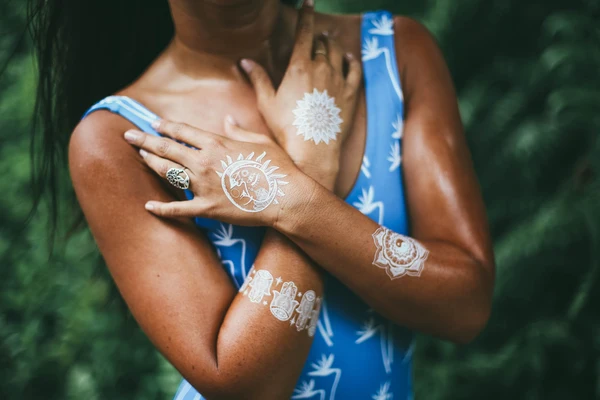
You can also use contrast to organize the arm. A white tattoo beside a dark black motif can create a highlight effect, while a delicate geometric piece can soften a heavier graphic. Place contrasting designs where you want the eye to pause, and use related designs where you want the eye to travel.
A rotating collection can make this process more creative. A monthly tattoo subscription offers new temporary designs over time, allowing you to refresh the sleeve without repeating the same arrangement. Keep a few favorite pieces aside so you can rebuild the composition when the original tattoos fade.
After applying the full layout, inspect the sleeve in natural light. Look for accidental tangencies, such as a line ending directly against another tattoo or two dark shapes merging into one. Small changes in placement can create clearer separation and improve the overall balance.
Care also affects the final appearance. Avoid excessive rubbing, prolonged soaking, and applying oils directly over the artwork. Pat the skin dry after washing and choose clothing that will not constantly scrape against the design. With gentle care, quality temporary tattoos can remain crisp long enough to enjoy the complete arrangement.
Use a soft cosmetic oil or an oil-based cleanser when you are ready to remove the sleeve. Work gradually rather than scrubbing, especially around fine linework or sensitive skin. Once the arm is clean, moisturize lightly and give the skin a break before creating another layout.
Creating a sleeve effect with multiple temporary tattoos is a chance to treat body art like a flexible design project. Begin with a strong focal piece, guide the eye with varied scale, and use black, white, and negative space to create structure. Explore coordinated artist designs, test several layouts, and build a temporary sleeve that reflects your style today—then change it whenever a new idea takes shape.
Posted on
Posted on
Posted on

Posted on

Posted on

Posted on
Posted on